|
A found feather provides joy as only a few objects do with
such immediacy. As signs of flying, feathers hint at possibilities,
at lightness, at hovering. They are linked with notions of
how the space turns when you are in the air and all horizons,
all perspectives lose their reference to a fixed point of
view. The feather is a symbol of the negation of erverything
that is heavy, of all hindrances, a symbol of talking off
without effort and a controllable fall. Men have always thought
it unfair that birds have feathers and they do not. Imitating
birds has thus remained one of man's lasting goals. Since
feathers make it possible to fly, protect against heat, cold,
and wetness, and are both disguise and adornement, a comlex
cosmos of communicatively erotic signals, they are to be regarded
as "artifacts" of another world in its own right. The world
of eagles, falcons, pigeons, swallows, and birds-of-paradise
with its enormous impact on all forms of symbolizing has left
its mark on patterns, even on patterns of utopian mobile societies
whichbelieve in having found their rules forever. Yet, the
mechanically reflexive processes only resemble freedom even
in the feathered world. Nevertheless, this world still holds
many secrets: Despite all successes of investigation and copying,
nobody knows how flights coordinate their wild and, as it
seems, often completely unmotivated maneuvers or how the navigation
of migratory birds works.
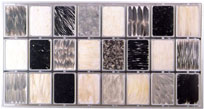
The comprehensive collection of feathers Béatrice Stähli
draws upon in her recent works dates from a time in which
rules of conservation had not set certain limits to the decimation
of endangered species. Treating the feathers almost as relics,
Stähli increases the value of her finds and emphasizes their
melanconically aura. But what they stand for at first sight
is laconically minimized and transformed through the way they
are presented. The exotic character of their material and
its seductiveness, the stereotypical images of beauty, pride,
and natural freedom each original plumage triggers, are exposed
to a present-day differentiating gaze. What one remeins aware
of is the fact that romantic approaches shape meanings independently
of all deconstruction. And, at the same time, one is irritated
that a lot of things have happened to the feathers and the
associations linked with them, as a number of them found in
one place, be it in nature or in a store, generally points
to some tragedy. Being declared to be something artificial
and traded as merchandise, the differences to the natural
are blured. In some cases, the colors and the marking of the
feathers still correspond to the original condition; in others,
they have been changed. What seems to be rare becomes more
valuable, dearer. Feeble gray and black shades are regarded
as too trite. Stähli uses such differences in order to let
the material show itself off to advantage. It is what it is.
Forming feather surfaces, feather bodies, or mobile objects,
the material, even if it has been colored, reveals how subtly
it reflects light and how its qualities, in a very nuanced
manner, allude to the functions in which the existence of
feathers is grounded.
Among birds, part of the more conspicuous plumage is female,
part male; among men, the more impressive plumes were reserved
for chiftains and kings who wanted to distinguish themselves
clearly from others. The feather itself has preserved a female
aura.
Translation: Wolfgang Astelbauer
|
 Béatrice Stähli: Supermarkt
 |